
Have you ever walked into your home on a hot summer afternoon only to feel like your air conditioner has waved the white flag? Your AC has been running nonstop, your energy bill is creeping higher and higher, yet the house still feels warm. If that sounds familiar, you’re not alone.
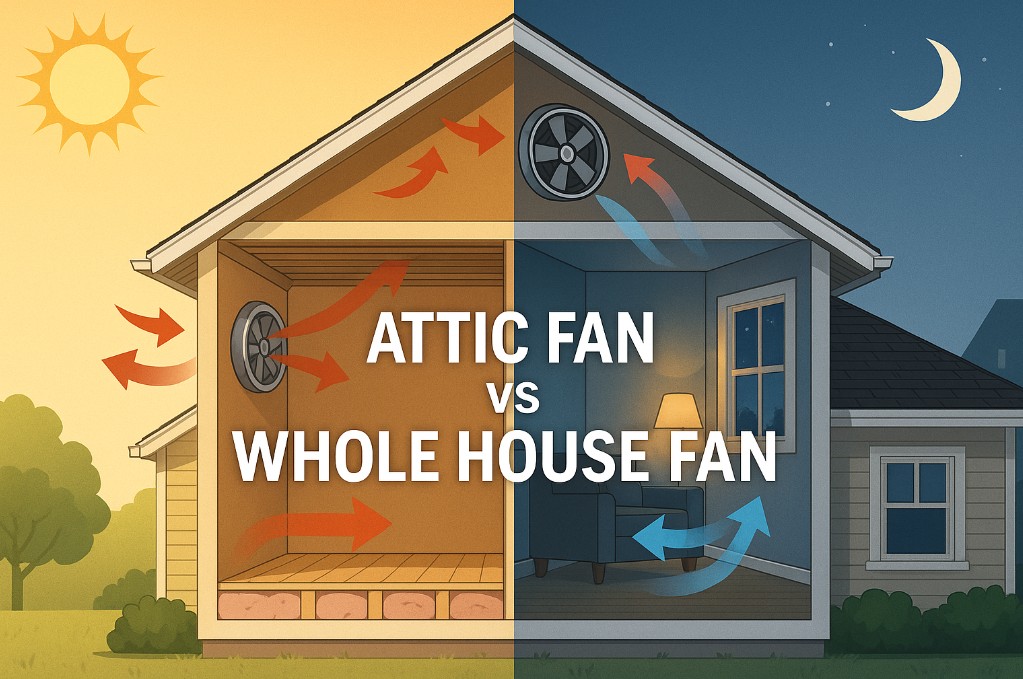
Most homeowners don’t realize that the battle against heat starts in the attic. And if your attic is an oven, your AC is fighting a losing war. The good news? There are two powerful solutions: attic fans and whole house fans.
They sound similar, but they serve two very different purposes. And if you use them together, you can dramatically lower your cooling bills—sometimes by as much as 90%.
Let’s break it down.
What Is an Attic Fan?
An attic fan is installed in your attic to keep that space from overheating. On a 100° day, your attic can easily reach 160° or more. That heat doesn’t just stay up there—it radiates into your living space, forcing your AC to cycle constantly.
Here’s how an attic fan helps:
- It ventilates hot air out of the attic.
- Keeps attic temperatures closer to 105° instead of 160°.
- Helps your AC run less often and more efficiently.
- Prevents your AC from wearing out prematurely.
Think of it like giving your home a “pressure release valve.” Instead of your AC fighting trapped heat all day, the attic fan keeps temperatures manageable.
Energy Savings: Homeowners with attic fans can save up to 30% on AC usage, just by reducing the attic’s heat load.
What Is a Whole House Fan?
If attic fans are the daytime warriors, whole house fans are the nighttime champions.
Here’s how they work: once the outside temperature drops below your indoor temperature (usually evening to early morning), you open your windows and switch on the whole house fan. The fan pulls in cool outdoor air while pushing out hot indoor air through the attic vents.
The benefits are huge:
- Thermal mass cooling: It doesn’t just cool the air, it cools the walls, floors, and furniture. This means your house stays cooler longer the next day.
- Instant comfort: The breeze can make you feel up to 10° cooler instantly.
- Cleaner air: Whole house fans flush out cooking smells, musty odors, or stale air in minutes.
- Massive energy savings: Whole house fans can cut AC usage by 50–90%.
It’s like hitting the reset button on your home every night.
Attic Fan vs Whole House Fan: What’s the Difference?
If you’re wondering which one is better, the truth is—they’re designed for different jobs.
Here’s a simple comparison:
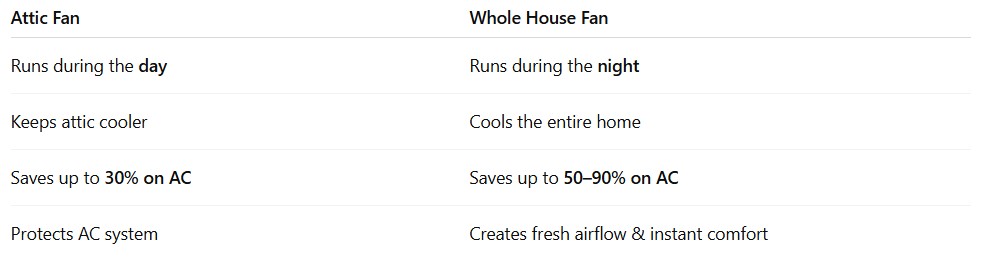
Both are powerful tools. But together, they’re unbeatable.
Why the Best Solution Is Both Together
Imagine this:
- Daytime: Your attic is blazing hot, but the attic fan keeps it under control so your AC doesn’t have to work as hard.
- Nighttime: The whole house fan pulls in crisp, cool air, flushing out the heat built up during the day.
This one-two punch means your home is comfortable 24/7. Families who install both have reported saving up to 90% on cooling costsall while enjoying fresher, cleaner, more comfortable air.
And because modern fans are designed with quiet motors and suspension systems, you don’t have to deal with loud rattling or humming.
Is It Worth It for Your Home?
Here’s a quick checklist to see if attic fans or whole house fans are right for you:
- Does your attic feel unbearably hot in summer?
- Is your AC constantly running but still struggling to keep up?
- Are your energy bills climbing every month?
- Does your home feel stuffy or retain heat even at night?
If you said yes to any of these, an attic fan, a whole house fan—or both—could be the missing piece to your comfort and energy savings.
Real-World Example
Think about getting into your car on a hot summer day. If you only turn on the AC, it eventually cools down—but it takes a long time. Now imagine rolling down the windows and driving for a few minutes. The car cools down much faster.
That’s exactly what whole house fans do for your home. They “open the windows” for your entire house, pushing hot air out and pulling cool air in—fast.
Final Thoughts
Cooling your home doesn’t have to mean running the AC nonstop and dreading the next utility bill. With attic fans and whole house fans, you can create a cooler, fresher, and more energy-efficient home—day and night.
When used together, they’re one of the smartest investments you can make for your comfort and your wallet.
Ready to see how much you could save?
Book a free consultation today and let’s find the right fan solution for your home.