
Blown-in insulation works as a two-person system, with one person at the truck and one person in the attic. The material starts at the truck, where it’s dropped into the blowing machine and conditioned. From there, it travels through a hose, continues to break up and condition, and is delivered directly into the attic.
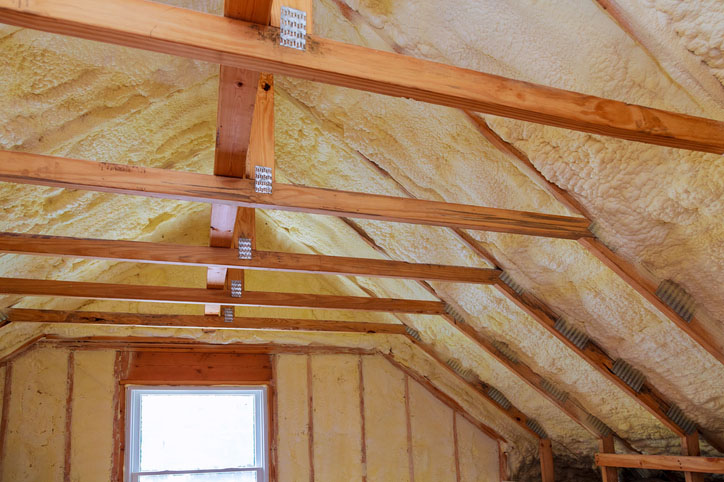
Once it’s blown in, it fills everything evenly. It doesn’t just sit between framing—it covers the tops of the joists and spreads out across the entire attic floor. Before installation begins, the machine settings are tested to make sure the material is flowing correctly and consistently. When it’s set up properly, the insulation fills over the top of everything and creates uniform coverage.
For this house, blown-in insulation is the right choice.
Depth and Coverage Are the Whole Point
To make sure the insulation performs correctly, depth is measured throughout the attic. This job is R-30, which for this product means 11 inches. That 11-inch depth is the target, and rulers are used to verify that the coverage is consistent.
The goal isn’t just insulation—it’s even insulation. That’s what creates a reliable thermal barrier.
Why Blown-In Makes Sense Around Wires and Lights
Attics aren’t clean, open spaces. There are recessed lights, electrical wires, framing variations, and catwalks. With batt insulation, everything has to be cut and fit around those obstacles. Wood isn’t standard width, and materials are often strapped or stapled down. That makes it difficult to get complete coverage without gaps or compression.
Blown-in insulation behaves differently. It flows around obstructions instead of fighting them. It wraps around wires, fills in around lights, and settles into irregular spaces. Like water in an ice cube tray, it naturally fills the voids instead of leaving spaces behind.
What’s Happening at the Truck Matters
At the truck, the second person is running the blowing machine. Bags are loaded into the machine, where the material is broken up and conditioned before being pushed through the hose. As it travels, the insulation continues to condition, which helps it spread evenly once it reaches the attic.
This process is what allows the material to arrive loose, consistent, and ready to fill the space properly.
The Finished Result
Once the attic is fully blown in, the result is continuous coverage with no gaps, no voids, and no missed areas. Even around cables, recessed lights, and walkways, the insulation wraps and fills instead of stopping short.
In this case, the attic becomes a complete barrier designed to resist heat transfer. This is a drop ceiling, but once the insulation is installed, it functions as a uniform thermal layer across the entire space.
Why Timing Matters
This house was recently rewired and had new ducts installed. There are no remodeling plans, and the plumbing is in good condition. There’s nothing left to address in the attic.
That makes this the right time to install blown-in insulation.
In situations like this, it is 60-70% more effective at insulating than batts.